


ANDROID APP DEVELOPMENT
Built with React Native and tested across the range of devices your users actually own, rather than the one in my hand.
THE ANDROID REALITY
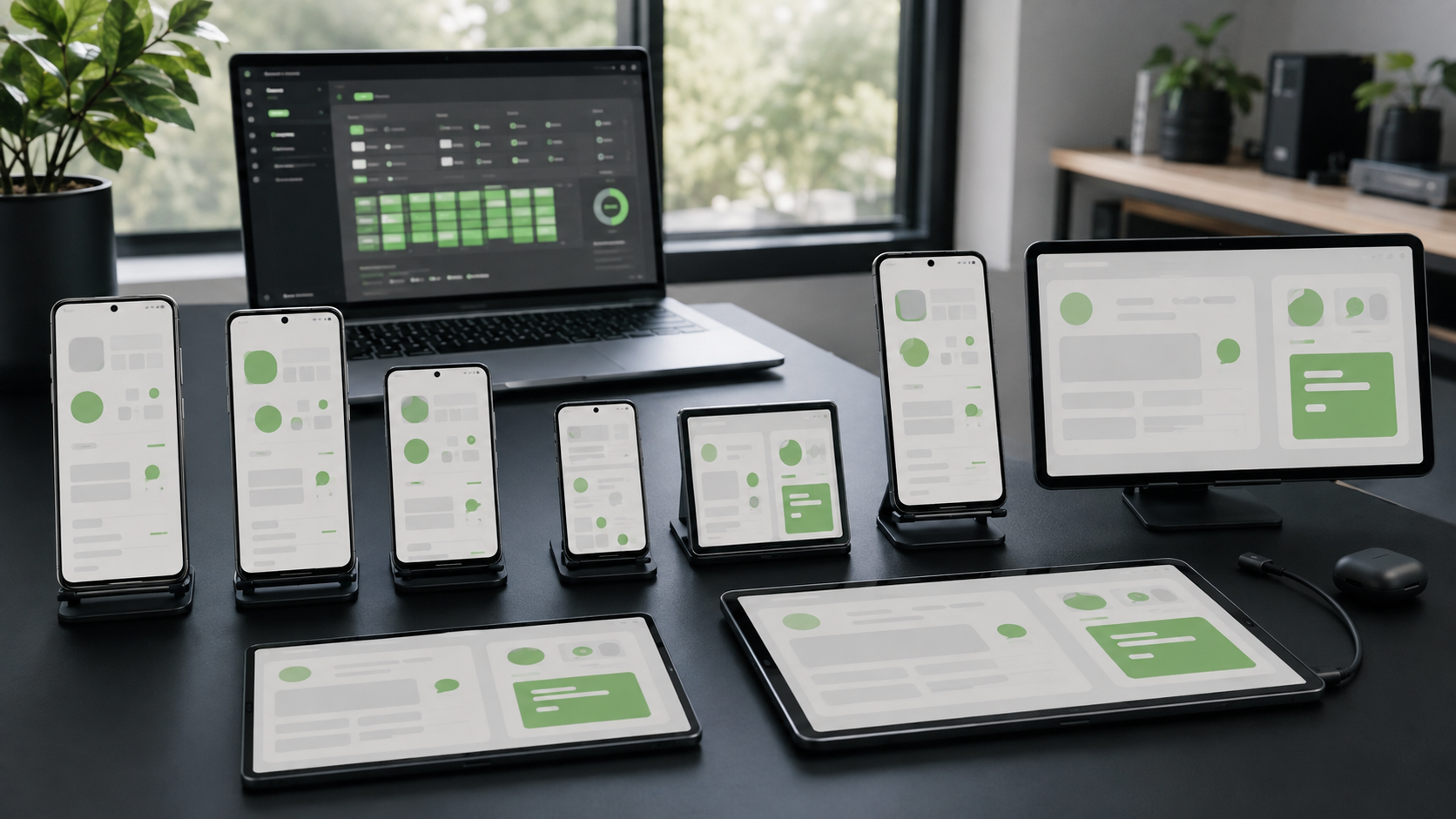
iOS runs on a manageable number of devices with predictable specifications. Android runs on thousands, with different screen sizes, densities, manufacturers, OS versions, and manufacturer-specific behaviour that ignores the documentation.
An app that works perfectly on a current flagship can be unusable on the mid-range device a large share of users own. Manufacturer battery optimisation kills background processes, and older OS versions handle permissions differently.
That is why Android testing is a real part of the work rather than a final check, and why emulator-only testing is not enough.
THE STANDARD
Test the devices your users own, not only the device on your desk.
WHAT I BUILD
A focused Android app can also become an iOS app from the same React Native codebase when that makes commercial sense.
Accounts, content, payments, and the reliable account flows people expect on a customer app.
Operational tools, including offline-capable workflows for teams working away from a desk.
An Android product connected cleanly to an existing web platform and backend.
Feature additions, performance work, and diagnosis of a React Native Android app that has slowed down.
Listing setup, submission, release management, and staged rollout support.
WHAT'S INCLUDED
The application, backend dependencies, device coverage, and Play Store route are handled as one project.
The application path, data model, integrations, and device realities before development begins.
A design direction that feels appropriate on Android without ignoring the product brand.
API work, payments, push notifications, maps, and analytics where the product needs them.
Coverage across screen sizes, densities, common device capabilities, and supported OS versions.
Play Store listing, staged release, source code, documentation, and credentials handed to you.
PLAY STORE RELEASE
Google review is faster and less unpredictable than Apple's, but it has its own requirements: a privacy policy, data safety declarations, target API level compliance, and content rating.
Play Console also supports staged rollouts, which is genuinely useful. Release to a small percentage first, watch crash rates, then expand. That is set up before the app reaches everyone at once.
“A reliable release is measured before it is rolled out to every user.”
COMMON QUESTIONS
The practical choices around Android build, testing, and release.
I build Android with React Native. For a project genuinely requiring native Kotlin, you want a native specialist and I will tell you that.
Yes, though with React Native the second platform costs little extra.
Typically current and several versions back, based on actual user distribution rather than a default.
If it is React Native, yes. Native Kotlin or Java apps are outside what I do.
Yes, including the listing, declarations, and staged rollout.
Real devices covering common sizes and specifications, plus cloud device testing for broader coverage.
Tell me what it does and who uses it. You will get a clear route to build and release.
